Phishing pages that imitate OnlyFans sign-in screens are one of the most common ways subscribers lose access to their accounts. The pages look ordinary, the emails sound routine, and the damage is often done before anyone notices. This guide explains how these attempts work, how to recognise them, and what to do when a password has already been typed into the wrong form.

A subscriber account rarely holds a large balance, so it can seem like a low-value target. In practice, saved cards and stored payment history make it worth attacking. One stolen login can lead to repeated charges, unwanted messages sent from the account, and a locked-out owner who has to rebuild trust with a creator.
Why subscribers get targeted
Free pages remove the subscription fee but not the payment link. A page set to a price of $0 still earns through pay-per-view messages and tips, and both run through the same card on file. That means even a subscriber who never pays a monthly fee has billing details attached to the account.
Paid subscription pricing runs from $4.99 at the minimum to $49.99 at the maximum, with most paid pages sitting between $4.99 and $15 and an average around $5 to $10. There is no base price below $4.99, though a promotional first month can dip lower. Anyone promising a permanent rate outside that range is describing something the platform does not offer.
Recurring charges also create predictable timing. A subscriber expects a charge near the same date each month, so a message about a billing problem fits neatly into the routine and raises less suspicion than it should.
- A monthly subscription between $4.99 and $49.99, most often $5 to $10
- Pay-per-view unlocks that are charged individually
- Tips sent directly to a creator
- Renewal charges that repeat on a fixed date
- No extra platform fee shown to the subscriber on top of these
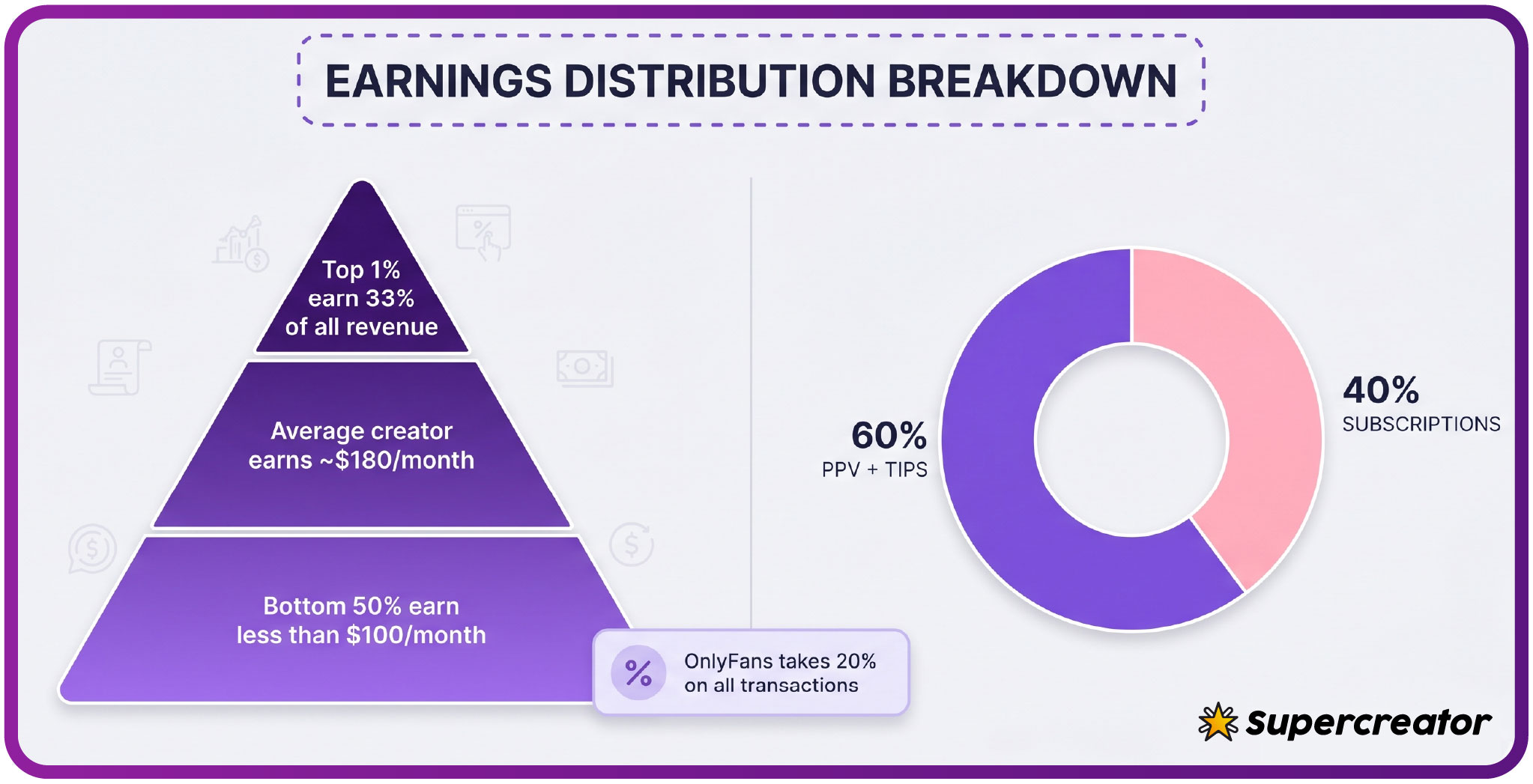
The platform takes 20% of everything, including subscriptions, tips and pay-per-view, and the creator keeps 80%. Subscribers sometimes assume a lower fee exists on one side of the transaction, and phishing messages exploit that gap by offering refunds or discounts that do not exist.
Warning signs in a login page
A cloned sign-in page usually gets the layout close and the details wrong. The fastest check is the address bar, not the design. If the domain is not the official one, nothing else on the page matters.
Security indicators are the second check. A padlock confirms a connection is encrypted, not that the site is genuine, so it should never be treated as proof on its own. Look instead at whether the login form asks for anything beyond a username and password.
- A domain that adds words, hyphens, or extra endings around the brand name
- A padlock present but no matching domain in the address bar
- Requests for a full card number, CVV, or banking login inside a sign-in form
- Urgency banners counting down or warning of suspension within hours
- Forms that ask for a one-time code before the password step
A practical rule: never enter login details on a page you reached by clicking a link in a message. Open a new tab, type the address yourself, and sign in there instead.
Legitimate sign-in flows do not ask for two-step verification codes at the password stage, and they do not ask for card details outside a payment screen. When both appear together on one page, the page is not a sign-in page at all.

Message patterns to distrust
Phishing messages rely on a small set of familiar stories. They are usually written to sound administrative rather than personal, and they almost always push the reader toward a link rather than toward the app or a typed address.
The subject lines shift between billing trouble and account expiry. Both are designed to trigger a quick reaction instead of a careful one, and both tend to arrive at odd hours when support would not normally be sending anything.
- A billing failure notice that asks for card details to restore access
- A warning that the account will be closed within a short window
- An offer of a discounted renewal that must be claimed through a link
- A message claiming a subscription was cancelled and needs confirmation
- A request to verify identity by uploading a photo of a payment card
Subscription changes are worth understanding here. When a creator raises the price, auto-renew stops, and existing access continues until the current paid period ends.

Real versus fake, side by side
The table below compares the details that separate a genuine sign-in screen from a clone. Read it as a checklist rather than a description, because the differences are small and easy to miss under time pressure.
| Check |
Genuine sign-in |
Cloned page |
| Domain format |
Official domain, typed or bookmarked |
Extra words, hyphens, or unusual endings |
| Security indicators |
Padlock plus correct domain in the address bar |
Padlock shown with a mismatched domain |
| Request type |
Username and password only |
Card number, CVV, or bank login requested |
| Code requests |
Two-step code asked after the password |
Code requested before or instead of a password |
Domain checks take a few seconds and catch most attempts. The rest are caught by noticing what the page is asking for, since a genuine login never needs payment details to complete. A practical starting point is best only fans card checks, which lists pages by the signals above.

What to do if you entered details
Speed matters more than damage control later. Change the password from a device you trust, and do it through a typed address rather than any link still open in the browser.
Then enable two-step verification and review the card on file for charges you do not recognise. A ranking service such as BestOnlyFans compares public profile prices, promotions, activity and media counts, which helps when checking whether a subscription you are paying for is still the one you chose.
- Do not reuse the leaked password anywhere else
- Do not reply to the message or confirm anything to the sender
- Do not upload identity documents to a page reached from a link
- Do not delay the password change until the next billing date
- Do not assume a small charge is harmless and ignore it
Card review should cover small test charges as well as large ones. A low-value charge is often used to confirm that a card still works before a bigger one follows.
For additional protection, a resource covering best only fans card checks explains how to review saved payment methods and spot charges that do not match your own subscription list.

Leaked password habits worth fixing
Most damage from a single leaked password comes from reuse. One breach becomes several accounts when the same credentials open more than one service, and the second service is usually the one with saved payment details.
The platform charges 20% on subscriptions, tips and pay-per-view, with the creator keeping 80%. That split is public and fixed, which means any message quoting a different fee structure is a reliable sign that the sender is not part of the platform.
- Using one password across several sites with similar usernames
- Keeping an old password after a service announces a breach
- Storing passwords in an unsecured note or a shared document
- Ignoring prompts to update a password that has already leaked
A password manager removes most of this risk, because it generates a different value for each site and fills it only on the matching domain. That single detail quietly blocks a large share of cloned login pages.
Reporting and blocking
Report the message through the platform it arrived on, then block the sender so follow-up attempts cannot land. Reporting inside the app or email client is faster than writing to support, and it feeds the filters that catch similar messages for other people.
There is no built-in discovery feed or directory on the platform, which is why ranking sites exist in the first place. That same absence means no legitimate message will ever ask you to claim a listing, verify a ranking, or confirm a profile through an external page.
BestOnlyFans is one example of a comparison service that lists public profile information such as pricing, promotions, posting activity and media counts. A second look at how these rankings are built helps explain why no platform message would ever request login details to confirm a position on one.
Keep a record of the sender address, the date, and the link before deleting the message. That record is useful if a charge later appears on the card.
Phishing pages copy a real login screen, so a login link that arrives in a message deserves a second look.
A pre-login checklist
Run the same short routine every time before typing credentials, on any device. It takes under a minute and removes almost every opportunity a cloned page depends on.
| Step |
Check |
| 1 |
Close the message and open a new tab |
| 2 |
Type the address manually or use a bookmark |
| 3 |
Read the domain in the address bar word by word |
| 4 |
Confirm the form asks only for username and password |
| 5 |
Enter the two-step code only after the password step |
Anyone who follows those five steps is unlikely to be caught by a clone, even a well-made one. The routine works because it removes the click that phishing depends on.
BestOnlyFans refreshes its rankings every month.
FAQ
Can a cloned page steal my card if I never subscribe?
Yes. Free pages still earn through pay-per-view messages and tips, so a card stays on file, and a page that captures it can be used regardless of whether a monthly fee is charged.
Does raising a subscription price require me to click anything?
No. When a creator raises the price, auto-renew stops and existing access lasts until the current paid period ends, so no link or confirmation is needed.
Is a padlock enough to prove a login page is genuine?
No. A padlock only shows that the connection is encrypted, so the domain in the address bar still has to be checked separately.
What should I do first after entering details on a fake page?
Change the password from a trusted device using a typed address, then enable two-step verification and review the card for charges that do not match your subscriptions.

How to Spot Phishing Logins Targeting OnlyFans
Phishing pages that imitate OnlyFans sign-in screens are one of the most common ways subscribers lose access to their accounts. The pages look ordinary, the emails sound routine, and the damage is often done before anyone notices. This guide explains how these attempts work, how to recognise them, and what to do when a password has already been typed into the wrong form.
A subscriber account rarely holds a large balance, so it can seem like a low-value target. In practice, saved cards and stored payment history make it worth attacking. One stolen login can lead to repeated charges, unwanted messages sent from the account, and a locked-out owner who has to rebuild trust with a creator.
Why subscribers get targeted
Free pages remove the subscription fee but not the payment link. A page set to a price of $0 still earns through pay-per-view messages and tips, and both run through the same card on file. That means even a subscriber who never pays a monthly fee has billing details attached to the account.
Paid subscription pricing runs from $4.99 at the minimum to $49.99 at the maximum, with most paid pages sitting between $4.99 and $15 and an average around $5 to $10. There is no base price below $4.99, though a promotional first month can dip lower. Anyone promising a permanent rate outside that range is describing something the platform does not offer.
Recurring charges also create predictable timing. A subscriber expects a charge near the same date each month, so a message about a billing problem fits neatly into the routine and raises less suspicion than it should.
The platform takes 20% of everything, including subscriptions, tips and pay-per-view, and the creator keeps 80%. Subscribers sometimes assume a lower fee exists on one side of the transaction, and phishing messages exploit that gap by offering refunds or discounts that do not exist.
Warning signs in a login page
A cloned sign-in page usually gets the layout close and the details wrong. The fastest check is the address bar, not the design. If the domain is not the official one, nothing else on the page matters.
Security indicators are the second check. A padlock confirms a connection is encrypted, not that the site is genuine, so it should never be treated as proof on its own. Look instead at whether the login form asks for anything beyond a username and password.
Legitimate sign-in flows do not ask for two-step verification codes at the password stage, and they do not ask for card details outside a payment screen. When both appear together on one page, the page is not a sign-in page at all.
Message patterns to distrust
Phishing messages rely on a small set of familiar stories. They are usually written to sound administrative rather than personal, and they almost always push the reader toward a link rather than toward the app or a typed address.
The subject lines shift between billing trouble and account expiry. Both are designed to trigger a quick reaction instead of a careful one, and both tend to arrive at odd hours when support would not normally be sending anything.
Subscription changes are worth understanding here. When a creator raises the price, auto-renew stops, and existing access continues until the current paid period ends.
Real versus fake, side by side
The table below compares the details that separate a genuine sign-in screen from a clone. Read it as a checklist rather than a description, because the differences are small and easy to miss under time pressure.
Domain checks take a few seconds and catch most attempts. The rest are caught by noticing what the page is asking for, since a genuine login never needs payment details to complete. A practical starting point is best only fans card checks, which lists pages by the signals above.
What to do if you entered details
Speed matters more than damage control later. Change the password from a device you trust, and do it through a typed address rather than any link still open in the browser.
Then enable two-step verification and review the card on file for charges you do not recognise. A ranking service such as BestOnlyFans compares public profile prices, promotions, activity and media counts, which helps when checking whether a subscription you are paying for is still the one you chose.
Card review should cover small test charges as well as large ones. A low-value charge is often used to confirm that a card still works before a bigger one follows.
For additional protection, a resource covering best only fans card checks explains how to review saved payment methods and spot charges that do not match your own subscription list.
Leaked password habits worth fixing
Most damage from a single leaked password comes from reuse. One breach becomes several accounts when the same credentials open more than one service, and the second service is usually the one with saved payment details.
The platform charges 20% on subscriptions, tips and pay-per-view, with the creator keeping 80%. That split is public and fixed, which means any message quoting a different fee structure is a reliable sign that the sender is not part of the platform.
A password manager removes most of this risk, because it generates a different value for each site and fills it only on the matching domain. That single detail quietly blocks a large share of cloned login pages.
Reporting and blocking
Report the message through the platform it arrived on, then block the sender so follow-up attempts cannot land. Reporting inside the app or email client is faster than writing to support, and it feeds the filters that catch similar messages for other people.
There is no built-in discovery feed or directory on the platform, which is why ranking sites exist in the first place. That same absence means no legitimate message will ever ask you to claim a listing, verify a ranking, or confirm a profile through an external page.
BestOnlyFans is one example of a comparison service that lists public profile information such as pricing, promotions, posting activity and media counts. A second look at how these rankings are built helps explain why no platform message would ever request login details to confirm a position on one.
Phishing pages copy a real login screen, so a login link that arrives in a message deserves a second look.
A pre-login checklist
Run the same short routine every time before typing credentials, on any device. It takes under a minute and removes almost every opportunity a cloned page depends on.
Anyone who follows those five steps is unlikely to be caught by a clone, even a well-made one. The routine works because it removes the click that phishing depends on.
BestOnlyFans refreshes its rankings every month.
FAQ
Can a cloned page steal my card if I never subscribe?
Yes. Free pages still earn through pay-per-view messages and tips, so a card stays on file, and a page that captures it can be used regardless of whether a monthly fee is charged.
Does raising a subscription price require me to click anything?
No. When a creator raises the price, auto-renew stops and existing access lasts until the current paid period ends, so no link or confirmation is needed.
Is a padlock enough to prove a login page is genuine?
No. A padlock only shows that the connection is encrypted, so the domain in the address bar still has to be checked separately.
What should I do first after entering details on a fake page?
Change the password from a trusted device using a typed address, then enable two-step verification and review the card for charges that do not match your subscriptions.